










In the rapidly evolving landscape of IT infrastructure where workloads can be on-premises and in the public cloud, enterprises are increasingly moving away from traditional virtualization platforms. This is due to rising licensing costs and the limitations these older systems impose on modern cloud-native application needs. The shift towards Kubernetes, which can manage diverse workloads such as containers, virtual machines (VMs), and bare metal across on-premises and public cloud environments, accelerates the migration from traditional virtualization platforms.
The Limitations of Traditional Network Segmentation
Traditionally, enterprises have segmented their virtualized environments using VLANs and logical switches to create distinct virtual networks and security zones. This segmentation was primarily static VM environments. However, this traditional approach to network segmentation is ill-equipped to handle the dynamic nature of Kubernetes environments, where workloads are frequently created and destroyed, leading to rapidly changing network configurations and policies. Further, implementing traditional network microsegmentation on Kubernetes across on-premises and public cloud adds further complexity.
Calico’s Solution: Dynamic and Unified Microsegmentation
Calico’s microsegmentation capabilities are designed to address the shortcomings of traditional network segmentation in the age of Kubernetes and container-based architectures, and multi-cloud and hybrid environments. Calico provides a robust, dynamic, and high-performance network policy engine that supports a diverse range of workloads and scales across environments.
Key Features of Calico’s Microsegmentation:
- Observability: The Dynamic Service and Threat Graph is built on flow logs, and collects and analyzes information about applications and their communication flows. Using this information, it creates a comprehensive map that helps administrators eliminate the guesswork involved in understanding the applications’ upstream and downstream dependencies and policy gaps.
- Distributed IDS/IPS: Calico’s workload-centric IDS/IPS protects against network-based threats by ingesting different threatfeeds such as AlienVault by default and custom sources to pinpoint the source of malicious activity in case of a breach.
- Automated policy recommendations: Calico’s policy recommendation engine recommends policies based on the traffic flow of your workloads and can be enforced with just one click—no coding necessary. Further, all recommended policies can be modified before enforcement.
- Policy lifecycle management: Calico helps preview and stage policies prior to enforcement to secure workloads and understand policies’ impact on the application’s performance and security posture. It also provides immediate feedback on policy rule changes in the production environment before enforcement.
- Dynamic Policy Enforcement: Calico’s Dynamic Policy Segmentation delivers real-time network policy updates within milliseconds, ensuring immediate response to network changes and minimizing potential vulnerabilities.
- Policy as code: Calico implements network security and observability as code, enabling automated, scalable, and compliant workload management. It uses Kubernetes primitives and declarative models, using the same versioning that teams use for source code. It ensures continuous compliance and security for all components, regardless of deployment, distribution, or container type.
Supporting Single and Hybrid Environments
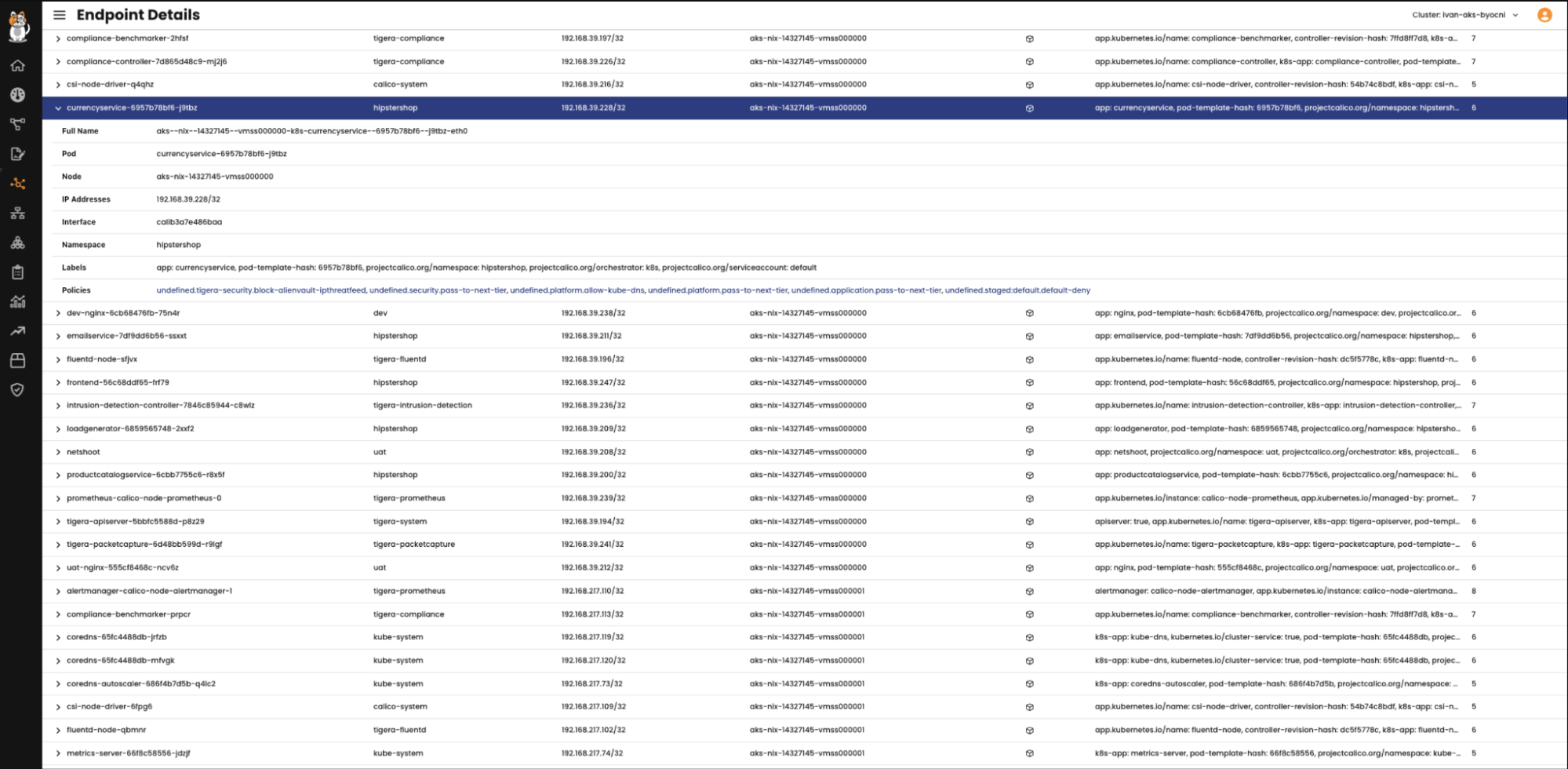
Calico excels in both single and hybrid virtualization environments. In single environments, Calico provides seamless segmentation for KubeVirt VMs and containers within Kubernetes pods. For both single and hybrid environments extending from on-premises to public cloud, it leverages the HostEndpoint resource to define network policies for traffic entering and leaving the host, whether it’s a bare-metal system or a VM running on a non-Kubernetes platform. In hybrid environments, administrators can manage multiple clusters with a single pane of glass, allowing them to select individual clusters and analyze traffic between different workloads and the associated enforced policies.
Key Benefits of Calico’s Microsegmentation:
- Unified Security Model: Calico offers a consistent security model across various environments, whether you are managing VMs, containers, or bare metal across on-premises and public cloud. This unified approach simplifies the enforcement and management of network policies, making it easier for enterprises to maintain security standards across their entire infrastructure.
- Dynamic Policy Enforcement: Network policies in Calico are dynamically applied as workloads move, are created, or terminated. This ensures that the network policies are always up-to-date, eliminating the need for manual intervention and reducing the risk of security gaps.
- Granular Policies: Calico allows for the creation of fine-grained policies that provide precise control over the traffic allowed or denied, catering to the specific needs of different workloads in a hybrid environment.
- Simplified Management: With its intuitive policy user interface and declarative policy language, Calico simplifies the creation and enforcement of network policies across environments. This ease of use is complemented by enhanced troubleshooting capabilities through the integration of flow logs and observability tools.
- Reduced Overhead: By consolidating multiple segmentation solutions into a single, efficient platform, Calico reduces the overhead associated with managing disparate security models and tools.
Conclusion
The migration from legacy virtualization platforms to modern solutions like Kubernetes and KubeVirt, driven by the need to reduce costs and manage diverse workloads efficiently across on-premises and public cloud, requires a new approach to network segmentation. Calico’s microsegmentation capabilities offer a powerful solution that meets these needs with a unified security model, dynamic policy enforcement, and simplified management. By adopting Calico, enterprises can ensure robust, efficient, and seamless segmentation for their evolving virtualization environments, paving the way for a more flexible and scalable IT infrastructure.
Get started with network segmentation using Calico. Request a demo.