









The AI revolution is here, and it’s running on Kubernetes. From fraud detection systems to generative AI platforms, AI-powered applications are no longer experimental projects; they’re mission-critical infrastructure. But with great power comes great responsibility, and for Kubernetes platform teams, that means rethinking security.
But this rapid adoption comes with a challenge: 13% of organizations have already reported breaches of AI models or applications, while another 8% don’t even know if they’ve been compromised. Even more concerning, 97% of breached organizations reported that they lacked proper AI access controls. To address this, we must recognize that AI architectures introduce entirely new attack vectors that traditional security models aren’t equipped to handle.
AI Architectures Introduce New Attack Vectors
AI workloads running in Kubernetes environments introduce a new set of security challenges. Traditional security models often fall short in addressing the unique complexities of AI pipelines, specifically related to The Multi-Cluster Problem, The East-West Traffic Dilemma, and Egress Control Complexity. Let’s explore each of these critical attack vectors in detail.
The Multi-Cluster Problem
Most enterprise AI deployments don’t run in a single cluster. Instead, they typically follow this pattern:
Training Infrastructure (GPU-Heavy)
- Dedicated clusters with high-memory GPU nodes
- Batch job processing for model training and fine-tuning
- Access to large-scale data stores and feature engineering pipelines
- Often deployed in public cloud for elastic capacity
Inference Infrastructure (Latency-Optimized)
- CPU or smaller GPU configurations optimized for low-latency responses
- Real-time prediction APIs with auto-scaling based on demand
- Often deployed on-premises or in edge locations for compliance and latency
- Integration with production application stacks
Development and Experimentation Clusters
- Mixed workloads for data science experimentation
- Access to production data for model development
- Often less stringently controlled than production environments
This multi-cluster architecture creates network policy enforcement gaps. A data scientist with legitimate permissions to the development cluster shouldn’t be able to access production model weights, but traditional Kubernetes security tools can’t enforce consistent policies across these distributed environments.
The East-West Traffic Dilemma
Big data technologies are used by AI workloads running in Kubernetes environments, and this creates larger east-west traffic volumes compared to non-AI workloads.
Consider the communication patterns in a typical machine learning pipeline:
- Data Ingestion Service → Preprocessing Pod: Raw training data (potentially 100GB+ files)
- Preprocessing Pod → Feature Store: Engineered features and metadata
- Training Controller → Distributed Training Pods: Model synchronization traffic
- Model Registry → Inference Pods: Model weight distribution (multi-GB files)
- Inference Pods → Vector Databases: Embeddings and similarity searches
Each of these communication paths introduces risk of data leakage. If an attacker compromises the preprocessing pod, they can potentially access sensitive raw training data. If they compromise the model registry, they can obtain intellectual property in the form of trained model weights.
Traditional network security tools treat this as generic pod-to-pod traffic. They can’t distinguish between legitimate model updates and unauthorized data extraction because they lack the context to understand what constitutes normal behavior in an AI pipeline.
Egress Control Complexity
AI applications often need fine-grained internet access that challenges traditional allow/deny network policies. Consider these common requirements:
| Service Type | Required Egress | Security Risk |
| LLM Inference | api.openai.com, api.anthropic.com | API key theft, prompt injection |
| Model Downloads | huggingface.co, pytorch.org | Supply chain attacks, malicious models |
| Vector Embeddings | External embedding APIs | Data leakage through embeddings |
| Data Enrichment | Third-party data APIs | Sensitive data exposure |
| Model Training | Cloud storage buckets | Data exfiltration to attacker-controlled endpoints |
The challenge isn’t just allowing these connections—it’s ensuring they’re legitimate. An AI agent that normally queries external APIs for legitimate business purposes could be compromised to exfiltrate sensitive data to the same external endpoints. Traditional firewall rules can’t distinguish between these scenarios.
Why Kubernetes Native Security Falls Short
Kubernetes provides network security APIs, but was designed before the current AI workload explosion. While its network policy APIs are adequate for many cloud-native applications, they create significant gaps when applied to the unique requirements of AI infrastructure, particularly in three key areas: NetworkPolicy Limitations, Multi-Cluster Gaps, and Insufficient Observability.
1. NetworkPolicy Limitations in AI Contexts
Kubernetes NetworkPolicy operates at Layer 3/4, which means it can control IP-based traffic but can’t understand application-layer context that’s critical for AI workloads.
Consider this practical example: An LLM (Large Language Model) inference service needs to call external APIs like OpenAI or Anthropic for certain queries, but it should be blocked from accessing internal databases or making unauthorized external calls. Traditional NetworkPolicy can either:
- Allow all external HTTPS traffic (creating data exfiltration risk)
- Maintain a static allowlist of external IPs (breaking when services change IPs)
- Block all external traffic (breaking legitimate AI functionality)
None of these options provide the FQDN-based, context-aware filtering that AI workloads require.
2. Multi-Cluster Networking, Security and Observability gaps
The average organization now operates multiple Kubernetes clusters for their AI workloads, but Kubernetes has no native way to achieve multi-cluster networking and enforce consistent security policies across these distributed environments.
This creates a number of practical problems:
- Teams have to implement separate multi-cluster networking tools
- Development clusters may have different network security policies from production
- Training clusters might allow data scientists access that should be restricted in inference environments
- Cross-cluster data flows (training cluster → inference cluster) lack consistent network policy enforcement
- Troubleshooting service communication across clusters can be difficult
3. Insufficient Observability for AI Workloads
Kubernetes native logging and monitoring don’t provide the visibility required to detect AI-specific attack patterns. Security teams need to understand:
- Which pods are making external API calls and to which endpoints?
- What data is flowing between pipeline stages?
- Which DNS queries indicate potential data exfiltration?
- How model inference patterns change over time (potential indicator of adversarial attacks)?
Standard Kubernetes audit logs capture basic API server interactions but miss the application-layer behaviors that indicate compromise in AI workloads.
How Does Calico Help Secure AI Workloads?
Calico delivers proven, enterprise-grade network security controls specifically designed for mission-critical LLM, inference, and training workloads.
For AI-driven companies, Calico bridges the gap between traditional workloads and AI services, allowing them to coexist securely on the same infrastructure while providing the confidence needed to scale AI initiatives safely.
Four Core Calico Capabilities for AI Workload Security
1. Microsegmentation for AI and Traditional Workloads
Calico provides granular network policies, staged network policies for testing, and network policy tiers for governance for workload and namespace-based isolation to achieve zero-trust microsegmentation across both AI services (LLMs, inference APIs) and traditional applications. This ensures that sensitive assets—training datasets, model outputs, and critical AI services—remain accessible only to authorized resources, drastically reducing breach possibilities.
Practical impact: Even in multi-tenant environments where development, testing, and production AI workloads share infrastructure, microsegmentation policies prevent lateral movement and data contamination between environments.
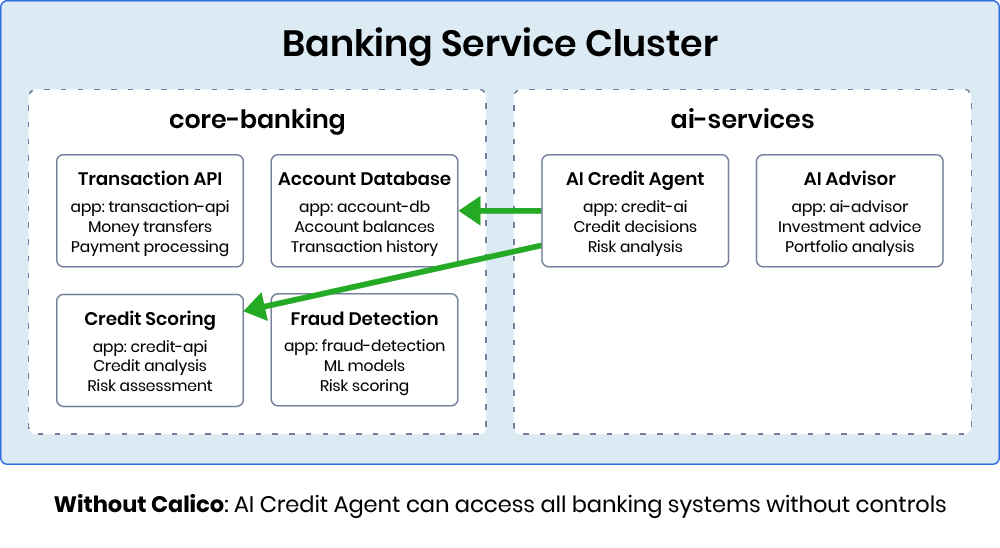
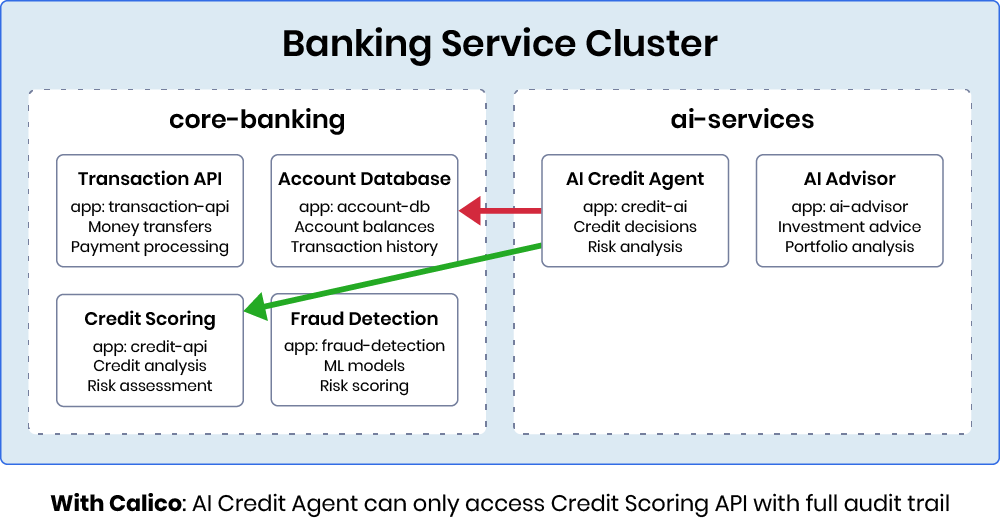
The following diagrams illustrate how Calico mitigates the risk of overly permissive access in a banking cluster by ensuring that AI agents, such as an AI Credit Agent, can only communicate with authorized microservices like the Credit Scoring API while blocking direct access to sensitive account databases.
2. Advanced Egress Controls for Intellectual Property Protection
- Prevent data exfiltration and protect model integrity: Models and training data represent some of the most valuable assets in modern enterprises. Calico’s egress controls, combined with DNS network policies, provide granular protection for these assets by controlling exactly what each service can communicate with.
Consider this threat scenario: If an attacker compromises a training container, traditional network security might allow them to exfiltrate terabytes of training data or call unauthorized external APIs. With Calico’s egress controls, that same compromised container is blocked from reaching unauthorized internal systems or external endpoints, containing the breach.
- Egress Gateway Architecture for AI Workloads: Calico’s egress gateway functionality creates a centralized, secure exit point for all outbound traffic from AI workloads. Rather than allowing pods to directly access external services, traffic is routed through dedicated gateway pods that can be monitored, logged, and controlled with granular policies.
AI Training Pod → Egress Gateway → External API (api.openai.com)
↓                ↓              ↓
Source IP         Centralized    Destination
Anonymized        Monitoring     Verification
3. Simplified Multi-Cluster and Multi-Team Operations
Most enterprise AI deployments span multiple clusters—dedicated training environments, optimized inference clusters, and integrated production systems. Calico’s cluster mesh feature enables unified network policy management across these distributed environments.
This architectural approach allows organizations to maintain separate clusters for different AI workload types while ensuring consistent security policies.
Practical impact: Training workloads in high-performance GPU clusters remain isolated from inference services in latency-optimized environments, with only authorized cross-cluster communications permitted.
4. AI-Specific Observability and Compliance
Calico provides detailed flow logs, DNS logging, and visual service graphs that help teams understand how AI services interact and identify misconfigurations before they become security incidents. This visibility is essential for compliance auditing and incident response in AI environments.
Practical impact: When a chatbot service attempts to connect to a model training service, Calico’s audit trail captures not just that the connection occurred, but the network policy decision that allowed or denied it, providing the forensic detail required for compliance reporting.
Calico in Action: Example Use Cases
| Security Challenge | Calico Solution | Real-World Application |
| Permissive AI Workload Access to Core services | NetworkPolicy + GlobalNetworkPolicy | Banking: Prevent GenAI chatbot pods from directly querying core transaction systems |
| Unrestricted AI Agent Access to External APIs | Egress rules with FQDN filtering | Fast Food Chain: Limit LLM-based order assistant to only approved 3rd-party APIs
Banking: Restrict mortgage co-pilot service to api.openai.com only |
| Training & Inference Workload Segmentation | Namespaces + tiered policies | Healthcare: Isolate patient-record retraining jobs from always-on patient-assistance inference APIs |
| Inter-Service Traffic Visibility | Flow logs, DNS logs, network policy audit trails | Banking: Track which agent pod accessed internal credit score service and when |
| Data Exfiltration Prevention | Global deny policy + DNS-based egress control | Financial Services: Block AI models from accessing unauthorized domains or uploading to personal cloud storage |
| Uncontrolled Intra-Agent Communication | Microsegmentation with label/namespace policies | Fast Food Chain: Ensure only orchestrator agent can trigger models; prevent direct agent-to-agent communication |
| Insecure Cross-Cluster AI Communication | Calico Cluster Mesh + WireGuard encryption | All Industries: Secure separate training, inference, and core service clusters with encrypted east-west traffic |
With Calico you can precisely control exactly which services and workloads your AI agents can access.
Securing the AI-Driven Future
The shift toward AI-powered applications is a defining moment for Kubernetes platform teams. As this article has explored, the unique nature of AI workloads creates complex security requirements that traditional models cannot meet. From the multi-cluster training and inference dilemma to the need for precise egress controls, the risks to intellectual property and sensitive data are higher than ever.
By implementing Calico, organizations can move past the limitations of native Kubernetes security. Calico provides the necessary microsegmentation, advanced egress filtering, and multi-cluster observability to build a true zero trust environment for AI. This approach ensures that as your AI agents become more autonomous, your security posture remains predictable and robust. Securely scaling AI on Kubernetes is no longer an obstacle but a competitive advantage. With the right guardrails in place, you can focus on innovation while maintaining total control over your most valuable AI assets.
Learn More: Request a demo to learn how Calico can secure your AI workloads.
Click here to request a demo today.
Sources and References:
- Mordor Intelligence. (2024, December 22). Kubernetes Market Size & Share Analysis. [https://www.mordorintelligence.com/industry-reports/kubernetes-market]
- EdgeDelta. (2025, March 13). Latest Kubernetes Adoption Statistics: Global Insights. [https://edgedelta.com/company/blog/kubernetes-adoption-statistics]
…
Shape the Future of AI Security
Is your organization deploying AI agents and wrestling with challenges around security and observability? Our product team is actively building solutions to address these gaps.
Share your insights and help us build the next generation of AI guardrails.