







What Are Kubernetes Security Tools?
Kubernetes security tools are purpose-built solutions to protect containerized environments orchestrated by Kubernetes. These tools address challenges introduced by dynamic container infrastructure, such as ephemeral workloads, increased network surface, and distributed application components.
Enterprises use them to automate the detection and mitigation of threats, ensure secure configuration, and maintain compliance within Kubernetes clusters at scale. A variety of Kubernetes security tools exist, each targeting different aspects of the security landscape, ranging from hardening images and containers before deployment to monitoring runtime activity, enforcing network policies, managing access, and generating compliance reports.
In this article:
- Key Features of Kubernetes Security Tools for Enterprise
- Notable Kubernetes Security Tools for Enterprise
Key Features of Kubernetes Security Tools for Enterprise
Container Image and Configuration Scanning
Container image and configuration scanning focuses on identifying vulnerabilities and misconfigurations before workloads are deployed to production clusters. These tools inspect container images for outdated packages, known CVEs, and security best-practice violations. They also analyze resource manifests and Kubernetes YAML files to flag misconfigured permissions or insecure settings that could be exploited if left unaddressed.
In large enterprises, scanning solutions integrate directly into the CI/CD pipeline, blocking vulnerable or non-compliant images from being deployed. Additionally, they provide actionable reports and remediation recommendations, helping development and operations teams collaborate on securing containers from the earliest stages of the application lifecycle.
Runtime Threat Detection and Response
Runtime threat detection and response tools monitor active clusters for suspicious activity, such as privilege escalation, unexpected network connections, or anomalous process executions. These solutions typically leverage behavioral analytics, rules, and machine learning to identify threats as they emerge, rather than relying solely on predefined signatures.
Upon identifying threats, these tools can automate response actions—like quarantining compromised pods, killing malicious processes, or alerting security teams with detailed forensics. Such automation reduces mean time to respond (MTTR) and limits the blast radius of incidents.
Network Security and Microsegmentation
Network security in Kubernetes extends beyond basic firewall rules, relying on microsegmentation to enforce granular controls between pods, namespaces, and services. Security tools enable enterprises to apply network policies that restrict east-west traffic, allowlist communication paths, and isolate sensitive workloads. These controls are essential for reducing the attack surface and containing breaches.
Microsegmentation tools also provide visibility into traffic flows and generate policy recommendations based on observed usage. By continuously monitoring changes in traffic patterns and new service deployments, they help ensure that network security policies remain effective and adapt to evolving application architectures.
Access Control and Identity Management
Access control and identity management tools help enforce least privilege principles across Kubernetes clusters. They integrate with organizational identity providers, implement RBAC (Role-Based Access Control), and define fine-grained policies that specify which users, groups, or service accounts can perform certain operations on Kubernetes resources. This reduces the risk of unauthorized access or privilege misuse within the cluster.
Advanced identity solutions provide auditing and session recording to trace all administrative activities and access attempts, supporting incident investigations and compliance obligations. They also simplify federation, supporting multi-cluster or hybrid cloud scenarios where users require access across multiple contexts.
Compliance and Audit Readiness
Compliance and audit readiness tools automate the assessment of Kubernetes clusters against regulatory frameworks and best practices (such as CIS Benchmarks, PCI DSS, or HIPAA). These tools continuously audit configurations, generate evidence, and surface policy violations in easy-to-understand formats for both technical and non-technical stakeholders.
For enterprises, audit readiness features translate to simpler, faster compliance reporting and easier remediation of failing controls. They often offer dashboards, scheduled reporting, and extensive integrations with governance systems. By embedding compliance monitoring within the operational workflow, organizations ensure that security and regulatory requirements are consistently met as clusters scale.
Related content: Read our guide to Kubernetes security policy
Notable Kubernetes Security Tools for Enterprise
1. Calico, by Tigera

Calico is a Kubernetes network security and observability platform designed for securing workloads across containers, virtual machines, and bare metal. It provides dynamic network security policies to prevent unauthorized access and lateral movement. Calico enables full workload portability and the ability to define segmentation policies for multi-cloud and hybrid connections. It is built for cloud scale and provides you with the ability to roll out security policy changes in milliseconds, while legacy segmentation tools take hours.
General features include:
- Dynamic segmentation: Uses workload metadata to enforce segmentation policies automatically, ensuring consistent security as workloads scale.
- Policy enforcement: Supports microsegmentation with fine-grained policy controls at the workload level. Policies can be staged, previewed, and modified before deployment.
- Supports container, VM, and bare metal: Ensures consistent security policy enforcement across diverse environments, including containers, virtual machines, and physical servers.
Enterprise features include:
- Visibility: Provides detailed insights into network activity and policy impact, enabling security teams to optimize segmentation strategies.
- Scalability: Designed for high-performance enforcement across large-scale cloud and hybrid environments without centralized bottlenecks.
- Automated policy recommendations: Analyzes workload behavior and suggests security policies, reducing manual effort and simplifying microsegmentation adoption.
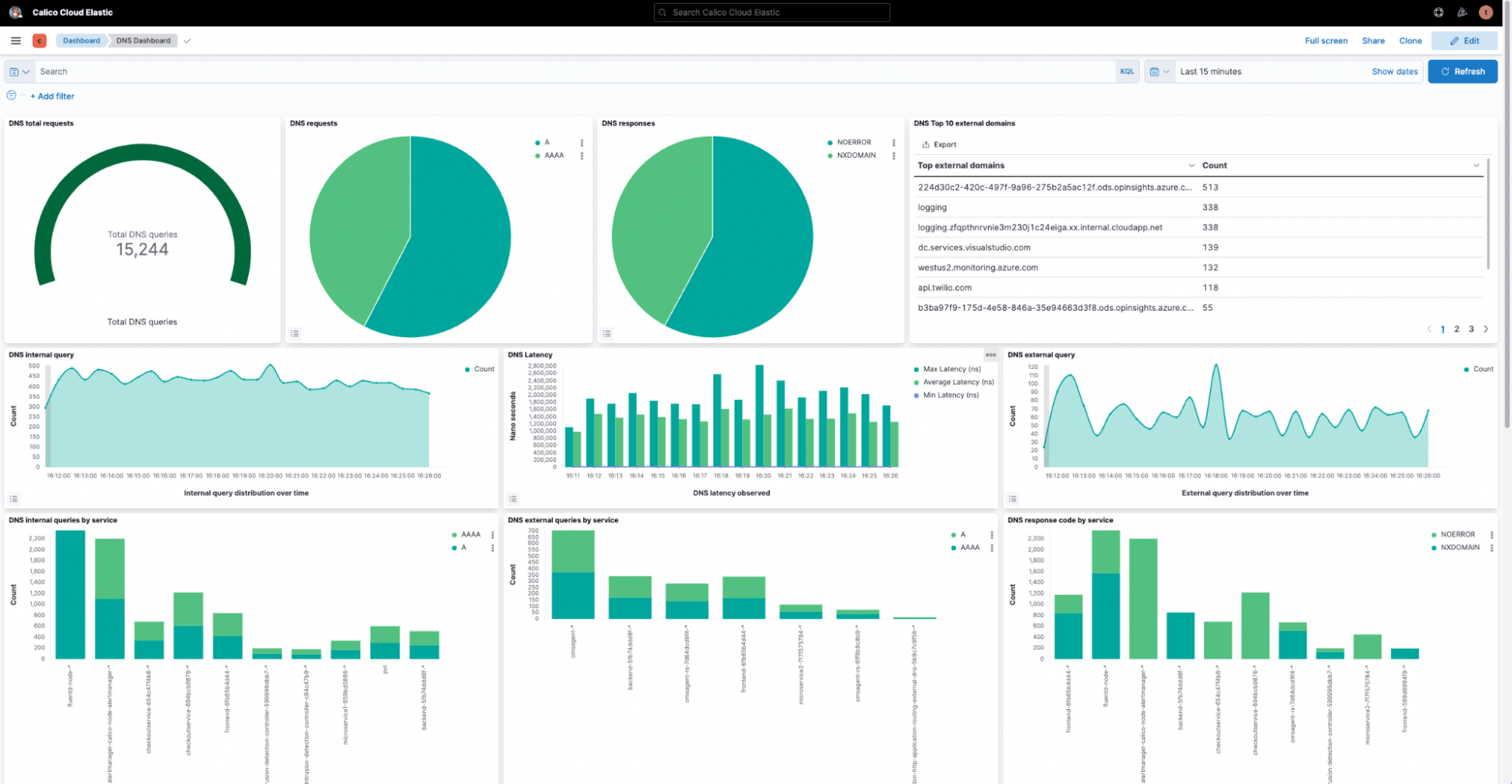
Source: Tigera
2. Prisma Cloud

Prisma Cloud is a Kubernetes security platform that integrates across the application lifecycle—securing source code, container images, and live workloads with threat detection, policy enforcement, and AI-enhanced risk insights. The platform is a Kubernetes Certified Service Provider (KCSP).
General features include:
- Code-to-cloud intelligence: Bridges developer activity and runtime environments by linking source code insights to workload behavior.
- Threat detection and runtime protection: Monitors running Kubernetes applications for malware, anomalies, and zero-day threats.
- Shift-left security: Integrates into development pipelines to prevent misconfigurations and known vulnerabilities from reaching production.
- Application context awareness: Classifies risks based on workload behavior and application structure.
- AI detection: Uses machine learning models to analyze events, detecting and categorizing new attacks every day.
Enterprise features include:
- Risk prioritization: Uses AI to assess the reachability and blast radius of risks across assets.
- Guided investigations and automated response: Offers investigation tools and automated workflows to reduce response times.
- Secure AI applications: Provides governance over AI model training data, integrity controls for models, and access management for deployed AI services.
- Integrated Copilot assistant: Allows users to query the security environment conversationally, receive actionable guidance, and automate fixes.
- Unified visibility: Offers a centralized dashboard that spans CI/CD, runtime, and infrastructure layers.
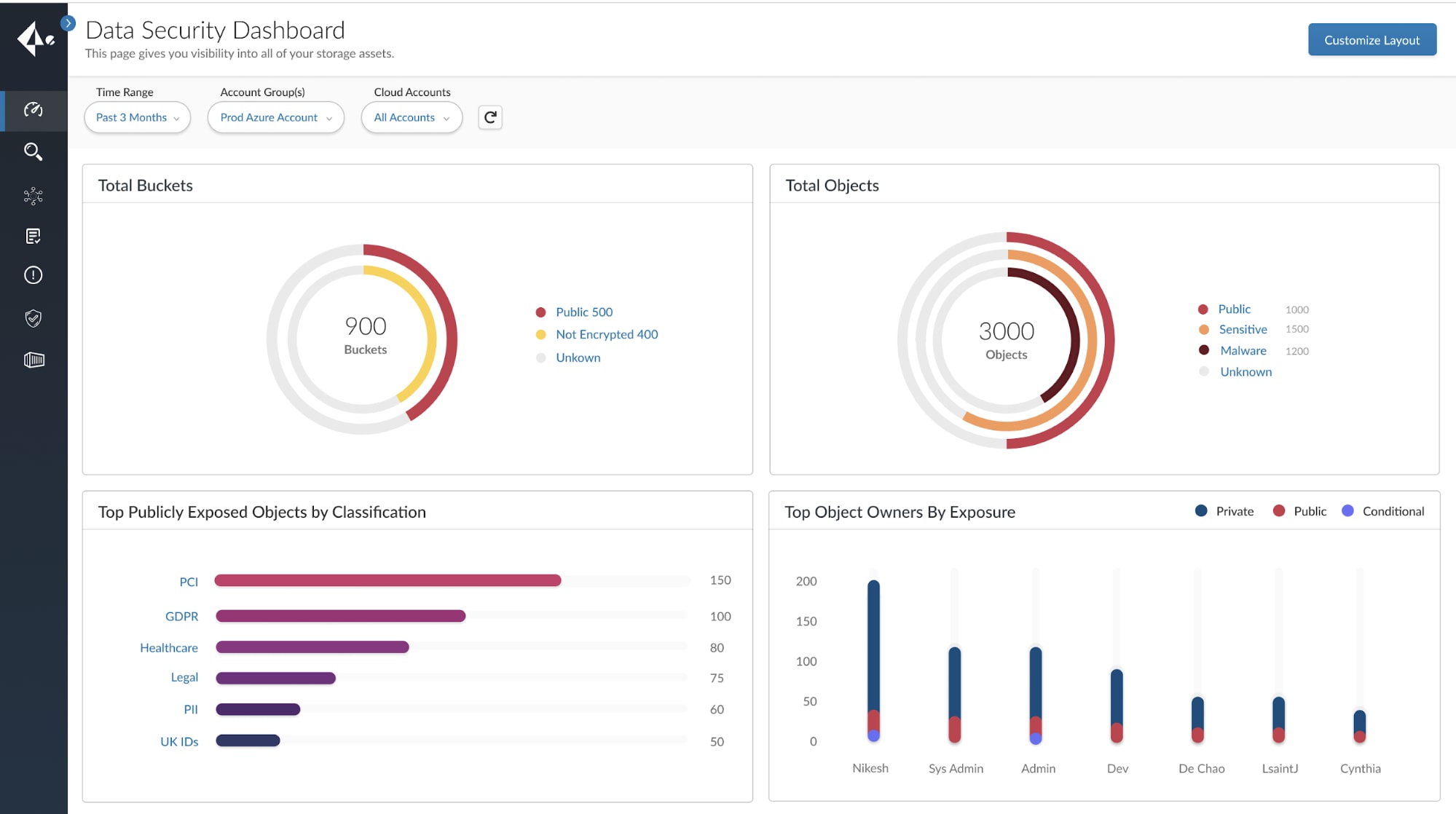
Source: Palo Alto Networks
3. Aqua Security

Aqua Security offers a suite of Kubernetes-native security capabilities that protect containerized applications throughout their lifecycle. It combines Kubernetes Security Posture Management (KSPM), runtime protection, compliance automation, and policy enforcement in one platform.
General features include:
- Policy-driven workload admission: Controls pod deployment by evaluating workload attributes using Open Policy Agent (OPA) and customizable Rego rules.
- Runtime protection: Detects and mitigates threats such as privilege escalations, suspicious processes, or unauthorized network activity through behavioral analysis and automated response.
- Risk visualization: Offers an interactive risk map of running Kubernetes environments, showing containers, nodes, namespaces, and their interconnections.
- Image assurance and compliance: Scans container images and Kubernetes configurations for CVEs, misconfigurations, and policy violations.
- Penetration testing tools: Includes open source tools like Kube-Bench for CIS Benchmark compliance checks and Kube-Hunter for simulating real-world attack vectors against clusters.
Enterprise features include:
- Identity-based segmentation: Implements identity-aware network rules within and across clusters. Supports major CNI plugins like Calico, Flannel, and Weave.
- Compliance automation: Performs automated CIS Benchmark checks and provides compliance reports.
- Least privilege enforcement: Analyzes RBAC roles and service account privileges against best practices.
- Multi-cluster support: Enables unified visibility and policy enforcement across hybrid or multi-cloud Kubernetes environments.
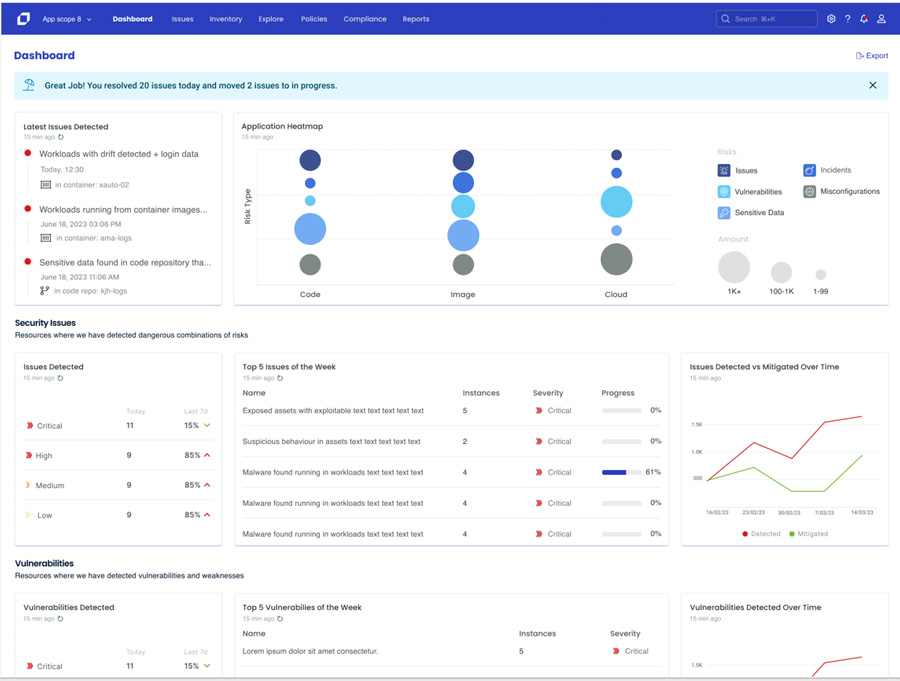
Source: Aqua Security
4. Anchore Enterprise

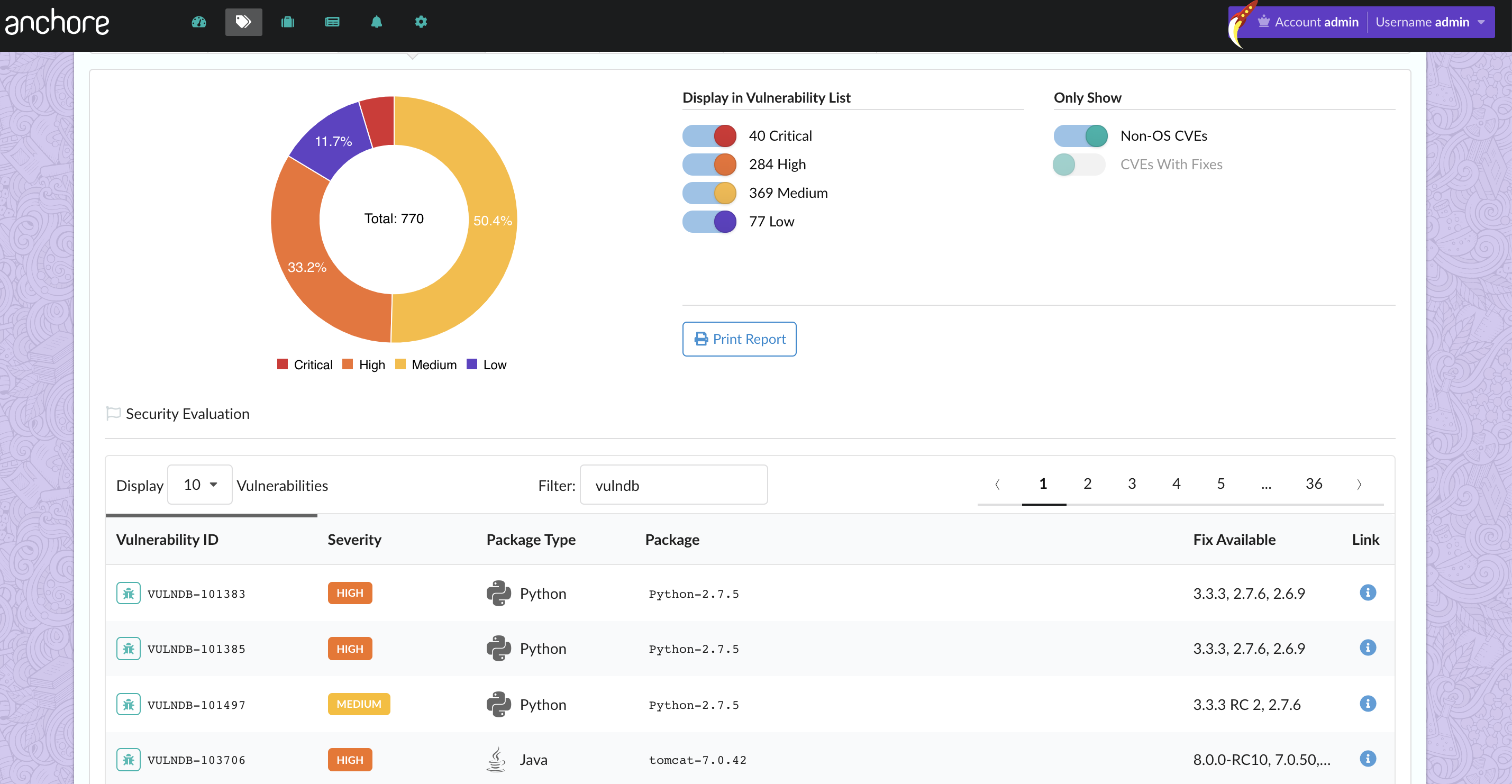
Anchore Enterprise is a Kubernetes-native container security platform that delivers continuous vulnerability scanning, compliance enforcement, and software bill of materials (SBOM) management. It secures cloud-native applications by integrating with CI/CD pipelines and Kubernetes environments.
General features include:
- Kubernetes image scanning: A Kubernetes admission controller enforces security policies at deployment, ensuring only scanned and approved images are admitted into clusters.
- Continuous container security: Monitors Kubernetes clusters for vulnerabilities in active containers, detecting exposures as new CVEs emerge.
- Ongoing visibility: Integrates with Kubernetes to continuously track the security status of running images.
- SBOM generation: Automatically generates software bill of materials at each build, commit, or deployment. Captures metadata, dependencies, and licenses.
- Continuous vulnerability scanning: Uses SBOMs to continuously scan for vulnerabilities, secrets, and malware.
Enterprise features include:
- Policy-as-code and compliance packs: Enforces security and compliance policies using JSON-based rules that are version-controlled via Git.
- Bring your own SBOM (BYOS): Allows importing of SBOMs from external sources, enabling security checks for third-party and internally built components.
- Cloud runtime inventory: Generates a live inventory of container images running across platforms like EKS, ECS, GKE, and OpenShift.
- License auditing and blocking: Automatically flags or blocks container images using unapproved open-source licenses.
- Custom Reporting and alerts: Produces reports for internal teams and external auditors, and sends alerts to developers via tool integrations.
Source: Anchore
5. Falco

Falco is an open source, cloud-native runtime security tool that detects anomalous and potentially malicious behavior across containers, hosts, Kubernetes, and cloud services. Developed by Sysdig and now a graduated CNCF project, Falco acts as a security camera for infrastructure.
General features include:
- Threat detection: Continuously monitors containers, hosts, and Kubernetes clusters for behaviors like privilege escalation, crypto mining, file exfiltration, or rootkit activity.
- Linux kernel-level monitoring: Uses eBPF or kernel modules to instrument syscalls for deep visibility into runtime behavior.
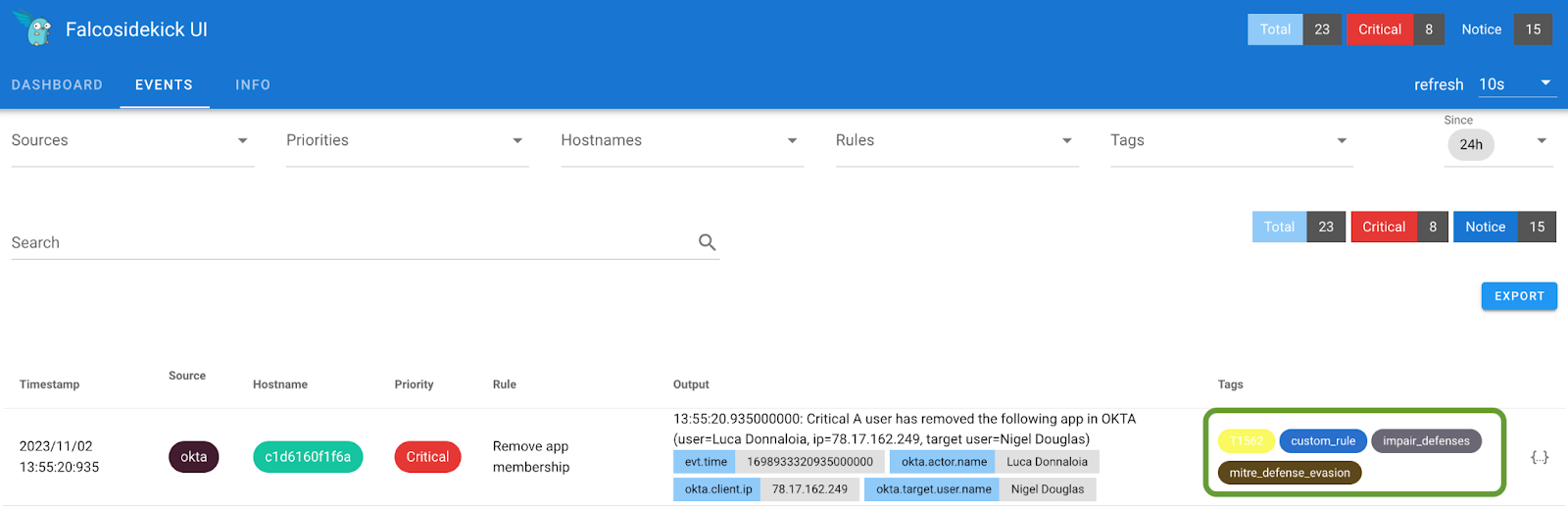
- Kubernetes and cloud integration: Enriches event data with metadata from Kubernetes audit logs and cloud services (e.g., AWS CloudTrail, GitHub, Okta).
- Built-in and customizable rules: Ships with a set of pre-defined security rules for Linux, containers, Kubernetes, and cloud environments. Users can extend these rules or create new ones to fit custom security requirements.
- Plugin architecture: Allows extension of event sources via plugins, enabling support for new services or platforms.
Enterprise features include:
- Falcosidekick integration: Acts as an alert distribution layer, forwarding Falco alerts to systems such as Slack, Teams, AWS Lambda, Splunk, and Kafka.
- Streaming alert delivery: Sends alerts using structured JSON format to integrate into SIEMs, data lakes, or automation platforms.
- Up-to-date rules via falcoctl: Ensures security rules are current with continuous syncing via falcoctl, a companion CLI tool that pulls updates from curated rule repositories.
- Multi-platform deployment: Runs across cloud providers and orchestration platforms including GKE, EKS, AKS, OpenShift, and gVisor. Supported on x86 and ARM architectures.
- Low overhead: Built on eBPF, it offers runtime monitoring without intrusive instrumentation.
Source: Falco
Conclusion
Kubernetes security tools are essential for securing modern containerized environments at scale. By covering every stage of the container lifecycle—from development and deployment to runtime and compliance—they enable enterprises to enforce security controls, detect threats in real time, and maintain regulatory posture across complex, distributed systems.