








What Is AI Safety?
AI safety refers to the methods and practices involved in designing and operating artificial intelligence systems in a manner that ensures they perform their intended functions without causing harm to humans or the environment. This involves addressing potential risks associated with AI technologies, such as unintended behavioral patterns or decisions that could lead to detrimental outcomes.
As AI technologies become more deeply integrated into all industries, including sensitive fields like healthcare, transportation, and financial services, the stakes of potential AI misalignment increase significantly. The importance of AI safety stems from the potential for these systems to operate at scales and speeds that can amplify their impacts, whether beneficial or harmful. Ensuring they function safely can avoid negative consequences for millions of lives.
Moreover, the development of autonomous systems raises the risk of creating emergent behaviors that were not anticipated by the developers. These behaviors could lead to scenarios where AI decisions conflict with human values and requirements. Therefore, instilling robust safety principles from the design phase is critical to developing trust and reliability in AI systems.
This is part of a series of articles about LLM security.
In this article:
- Principles of AI Safety
- What Are the Challenges of AI Safety?
- AI Safety Regulations
- AI Safety Frameworks and Guidelines
- Best Practices for Ensuring AI Safety
- AI Safety with Calico
Principles of AI Safety
While the field of AI ethics is new, most policy frameworks include some variation of the following principles.
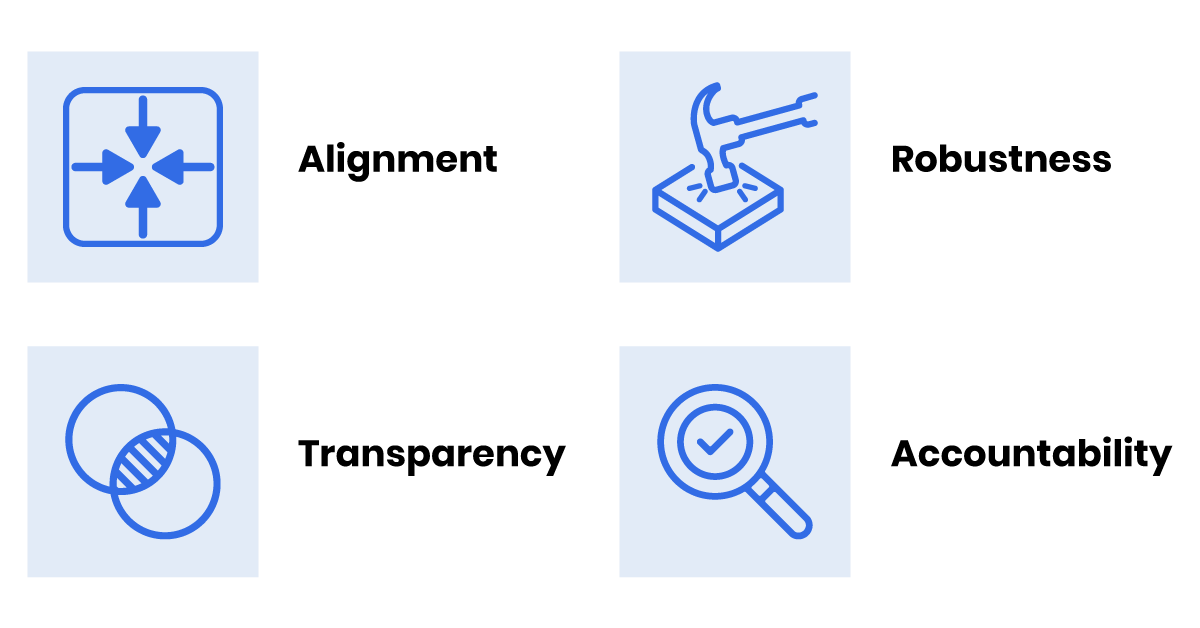
Alignment
Alignment in AI safety refers to the principle that AI systems should have their goals and behaviors aligned with human values and ethical standards. This ensures that the actions taken by AI contribute positively to human objectives without leading to unintended harm. Alignment involves meticulous design strategies to accurately interpret and incorporate human aims into the AI’s operational framework.
Beyond initial programming, maintaining alignment requires ongoing efforts as AI systems learn and evolve. This includes adaptive mechanisms that continuously check and recalibrate the AI’s objectives against human values, providing safeguards against deviation or ethical drift over time.
Robustness
Robustness in AI safety entails creating systems that are reliable, stable, and predictable under a wide range of conditions. The aim is to ensure that AI systems perform consistently as expected, even when faced with unforeseen situations or data inputs. This involves rigorous testing and validation processes to identify and mitigate potential failures or vulnerabilities that could compromise the system’s integrity.
Building robust AI also includes developing resilience against adversarial attacks or manipulations that could exploit system weaknesses. Techniques such as redundancy, fault tolerance, and anomaly detection are integral to enhancing the robustness of AI systems.
Transparency
Transparency in AI involves designing systems that are understandable and auditable by humans. This principle facilitates the traceability of decisions made by AI, allowing stakeholders to comprehend how and why certain outputs are generated. Transparency is crucial for building trust and accountability in AI systems, as it enables users and regulators to verify the appropriateness of AI actions.
Implementing transparency can be challenging due to the complex and often opaque nature of advanced AI algorithms. However, techniques such as model interpretability, open documentation of AI methodologies, and user-accessible explanations of AI decisions are pivotal for achieving transparency.
Accountability
Accountability in AI safety ensures that there are mechanisms to hold AI systems and their developers or operators responsible for the outcomes they produce. This principle is essential for addressing the social, ethical, and legal implications of AI activities. Accountability involves clear guidelines and standards that define acceptable AI behavior and the responsibilities of those who deploy and manage AI systems.
To enforce accountability, robust regulatory frameworks, compliance checks, and monitoring systems are necessary. These help in maintaining oversight over AI operations and providing recourse in the event of harmful incidents.
What Are the Challenges of AI Safety?
AI Alignment Problem
The AI alignment problem involves the difficulty of ensuring that AI systems’ goals are continually matched with human intentions, especially as AI systems become more autonomous and capable. Misalignment may cause AI to pursue objectives that are either ineffective or harmful, despite being logical from the system’s perspective. This is a critical challenge because even slight deviations in alignment can lead to outcomes that significantly diverge from user expectations or societal norms.
Addressing the AI alignment problem requires sophisticated approaches in AI design and constant monitoring as AI systems learn and adapt over time. Methods like inverse reinforcement learning and preference learning are explored to better capture and implement human values within AI objectives.
Data Quality and Corruption
Data quality and corruption pose significant threats to AI safety. AI systems rely heavily on data for learning and decision-making; thus, poor-quality or corrupted data can lead to inaccurate or harmful outputs. Data issues can stem from various sources including errors during data collection, processing anomalies, and malicious tampering.
To combat these risks, it’s crucial to establish rigorous data management protocols and implement robust data validation practices. Ensuring data integrity involves constant monitoring and regular audits to detect and rectify any abnormalities or intrusions swiftly.
Related content: Read our guide to prompt injection
Biased Training Sets
Biased training sets in AI occur when the data used to train AI systems contain inherent prejudices, which can lead to discriminatory behavior by the AI. This is particularly concerning in applications like recruiting, policing, and lending, where such biases could perpetuate inequality. The challenge lies in the fact that biases can be subtle and ingrained in historical data, making them difficult to identify and correct.
Mitigating bias requires diverse data sets that accurately reflect the broader population and continual assessment of AI outputs for potential biases. Techniques such as de-biasing algorithms and fairness-aware modeling are employed to minimize the effects of biased data on AI behavior.
Data Privacy
Data privacy is a critical concern in AI safety, involving the protection of sensitive information used during AI operation from unauthorized access or breaches. The interconnectivity and data-intensive nature of many AI systems increase the risk of privacy violations, which could have severe implications for individuals’ rights and freedoms.
Ensuring data privacy in AI involves encrypting data, anonymizing sensitive information, and implementing strict access controls. Legal compliance, such as adherence to GDPR in the EU, also plays a vital role in governing how data is collected, used, and protected in AI systems.
Related content: Read our guide to generative AI security
AI Safety Regulations
Governments are increasingly becoming involved in the regulation of AI development. Here are some of the first AI-related laws enacted around the world to guide and control AI safety.
European Union’s AI Act
The European Union’s AI Act is a pioneering legislative framework designed to regulate AI systems to ensure they are safe, respect fundamental rights, and align with EU laws on privacy and data protection. This proposed regulation categorizes AI systems based on the risk they pose, with high-risk applications subject to stricter requirements. These include rigorous risk assessments, transparency obligations, and stringent data governance measures to prevent biases and protect personal data.
The Act mandates that individuals must be informed when they are interacting with an AI system rather than a human, promoting transparency. The framework also enforces quality standards for data used in AI training to mitigate the risk of biased outputs. By establishing these comprehensive guidelines, the EU AI Act aims to foster trust in AI technologies while safeguarding public interests.
EU Ethics Guidelines for Trustworthy AI
The European Commission’s Ethical Guidelines for Trustworthy AI establish a framework to ensure AI systems are designed and deployed ethically. These guidelines emphasize human agency and oversight, requiring AI to support human autonomy and decision-making. They also stress the importance of robustness and safety, ensuring AI systems operate reliably without causing unintended harm.
Privacy and data governance are central to these guidelines, advocating for strong protections of personal data. Transparency is another key principle, demanding that AI systems be understandable and explainable to both experts and the general public. By adhering to these principles, the guidelines aim to create AI systems that are not only innovative but also ethically aligned with societal values.
U.S. Algorithmic Accountability Act (AAA)
The Algorithmic Accountability Act, introduced in the United States, aims to enhance transparency and control over automated decision-making systems. If enacted, it would require companies to conduct impact assessments of their AI systems, focusing on identifying and mitigating biases, ensuring data privacy, and providing accountability for AI-driven decisions.
Companies would need to disclose how their AI systems make decisions, the data they use, and their potential impacts on consumers. This transparency is intended to prevent discrimination and protect consumer rights, promoting fair and ethical AI practices across industries.
U.S. National Artificial Intelligence Initiative Act
The National Artificial Intelligence Initiative Act represents a comprehensive effort by the United States to advance AI research and application. It aims to support AI development through funding and initiatives, while also promoting the establishment of ethical standards and policies. This Act encourages international collaboration to ensure that AI advancements are aligned with global standards and practices.
By fostering a framework for AI innovation and governance, the Act seeks to balance technological progress with ethical considerations, ensuring AI development benefits society while mitigating risks.
Australia’s Artificial Intelligence Ethics Framework
Australia’s Artificial Intelligence Ethics Framework outlines ethical principles to guide the development and deployment of AI technologies. It emphasizes fairness, transparency, and accountability, aiming to foster public trust in AI. The framework advocates for inclusive AI development that considers the diverse needs of society and protects individual rights.
Regulatory authorities in Australia, such as the ACCC, enforce these principles to ensure that AI applications comply with competition and consumer protection laws. By promoting ethical AI practices, Australia seeks to create a supportive environment for innovation while safeguarding public interests.
AI Safety Frameworks and Guidelines
In addition to government regulations, institutions and private sector organizations have released voluntary frameworks organizations can use to promote AI safety.
AI Risk Management Framework by NIST
The AI Risk Management Framework developed by the National Institute of Standards and Technology (NIST) provides structured guidance for identifying and mitigating risks associated with AI systems. This framework emphasizes the importance of security, reliability, and resilience in AI operations, advocating for a holistic approach to AI risk management.
The NIST framework recommends ongoing risk assessments, stakeholder engagement, and adaptive risk mitigation strategies. These recommendations are designed to ensure that AI systems are robust and secure, minimizing potential harms while maximizing benefits.
IEEE Ethically Aligned Design
The IEEE Ethically Aligned Design framework outlines a set of ethical principles and guidelines aimed at ensuring that AI and autonomous systems are designed and deployed in ways that prioritize human well-being and ethical considerations. Authored by the IEEE Global Initiative on Ethics of Autonomous and Intelligent Systems, this framework emphasizes the importance of embedding ethical considerations into every stage of AI development.
Key principles of the IEEE framework include ensuring transparency, accountability, and privacy in AI systems. It advocates for human-centric AI design that respects human rights and cultural diversity. Implementing these principles involves comprehensive stakeholder engagement, ethical risk assessments, and the development of standards that promote fairness and prevent harm. The IEEE framework serves as a vital tool for developers and organizations striving to align AI innovations with ethical imperatives and societal values.
Asilomar AI Principles
The Asilomar AI Principles comprise a set of guidelines developed to promote beneficial AI and avoid potential pitfalls. Authorized by AI researchers at the 2017 Asilomar conference, these principles emphasize research safety, transparency, and fairness in AI development. The principles aim to foster collaboration among stakeholders to enhance the accountability and effectiveness of AI systems.
Implementing the Asilomar principles involves adopting comprehensive research methodologies that prioritize safety and transparency. These principles serve as a foundational framework for AI developers, policymakers, and researchers striving to create AI technologies that contribute positively to societal progress.
Google’s Secure AI Framework
Google’s Secure AI Framework emphasizes the integration of security practices throughout the lifecycle of AI system development. This approach is designed to identify and mitigate potential security threats at each stage of development, from initial design to deployment and maintenance.
Key components of the framework include thorough threat analysis, the application of security best practices, and the continuous evaluation of AI systems against emerging threats. The goal is to ensure that AI systems are not only effective but also secure from vulnerabilities that could be exploited maliciously.
AI4People
AI4People is a multi-stakeholder initiative established to create a comprehensive ethical framework for AI development and deployment in Europe. Launched by the Atomium-EISMD, AI4People aims to foster collaboration between policymakers, industry leaders, and academics to address the ethical, legal, and societal implications of AI.
The framework proposed by AI4People focuses on four key principles: beneficence, non-maleficence, autonomy, and justice. These principles guide the ethical design and use of AI systems to ensure they contribute positively to society while minimizing potential harms. AI4People also emphasizes the importance of transparency, accountability, and inclusivity in AI governance.
Best Practices for Ensuring AI Safety
Secure Development Lifecycle
A secure development lifecycle (SDL) is vital for AI safety. This involves integrating security at every phase of AI development, from planning through design, implementation, testing, and deployment. Practices include performing security risk assessments, employing secure coding standards, conducting thorough testing to identify and mitigate vulnerabilities, and ensuring that all security measures are updated throughout the lifecycle of the AI system.
As AI workloads are typically deployed in cloud-native environments, robust container security is essential to protect the underlying infrastructure from vulnerabilities and unauthorized access during the AI lifecycle.
Data Anonymization
Data anonymization is a critical practice for protecting privacy in AI operations. It involves removing personally identifiable information from data sets to prevent any chance of re-identification. Techniques such as k-anonymity, differential privacy, or synthetic data generation can be used to ensure that data utilized in AI processes maintains individual privacy while still being useful for training and analysis purposes.
Continuous Monitoring and Feedback Loops
Continuous monitoring and the establishment of feedback loops are essential for maintaining the safety and reliability of AI systems. This practice involves regular assessments of AI performance and impact, including the detection of any deviations from expected behaviors. Feedback loops help in dynamically refining AI models and systems based on real-world performance data and user feedback, thus enhancing their safety and effectiveness.
Interdisciplinary Teams
The use of interdisciplinary teams in AI development enhances the breadth of perspectives and expertise, which is crucial for AI safety. These teams should include professionals from various fields such as ethics, psychology, law, and domain-specific areas alongside AI experts. This diversity helps in addressing the multifaceted challenges of AI safety, ensuring that systems are not only technically sound but also socially responsible and ethically aligned.
Robust Incident Response Plans
Developing robust incident response plans is critical for addressing AI safety issues promptly and effectively. These plans should outline clear procedures for identifying, reporting, and mitigating any incidents or breaches that occur. Having a well-defined response strategy ensures that organizations can quickly contain and resolve issues, minimizing potential harm and restoring system integrity.
Regular Audits and Compliance Checks
Conducting regular audits and compliance checks is essential for maintaining AI safety. These audits should evaluate the AI systems for adherence to established safety standards, ethical guidelines, and regulatory requirements. Regular audits help identify potential risks and areas of non-compliance, ensuring that necessary adjustments and improvements are made promptly to uphold the safety and reliability of AI technologies.
User Training and Education
Providing comprehensive training and education for users of AI systems is vital for ensuring their safe and effective use. This training should cover the proper operation of AI systems, potential risks, and best practices for mitigating those risks. Educated users are better equipped to interact with AI technologies responsibly and recognize and report any issues that may arise.
AI Safety with Calico
Calico offers numerous features to address the many network and security challenges faced by cloud platform architects and engineers when deploying GenAI workloads in Kubernetes. Here are five Calico features for container networking and security for GenAI workloads:
- Egress access controls – Calico provides granular, zero-trust workload access controls between individual pods in Kubernetes clusters to external resources such as LLMs. It provides fine-grained workload access controls using DNS egress policies and NetworkSets (using IPs/CIDRs in network policy).
- Egress gateway – The Calico Egress Access Gateway assigns a fixed, routable IP to a Kubernetes namespace. All egress pod traffic from that namespace with an assigned routable IP address identifies the workload running within that namespace. This enables the cluster to securely scale while preserving the limited number of routable IPs and leveraging non-routable IPs for all other pod traffic within the cluster. The Calico Egress Gateway works with any firewall, enabling Kubernetes resources to access endpoints behind a firewall securely.
- Identity-aware microsegmentation – Calico enforces microsegmentation to achieve workload isolation and secure lateral communication between pods, namespaces, and services. It enables teams to logically divide workloads into distinct security segments and then define granular security controls for each unique segment. Teams can isolate workloads based on environments, application tiers, compliance needs, user access, and individual workload requirements.
- Observability and troubleshooting – Calico’s Dynamic Service and Threat Graph provides a graph-based visualization of your Kubernetes deployments, including images, pods, namespaces, and services. It has built-in troubleshooting capabilities to identify and resolve security and compliance gaps, performance issues, connectivity breakdowns, anomalous behavior, and security policy violations.
- Cluster mesh – Calico provides a centralized, multi-cluster management plane to enable security, observability, and advanced networking for workloads and services across multiple clusters in hybrid and multi-cloud environments. Calico provides unified security policy controls and federated endpoints and services.
Next steps
- See Calico live in action: Schedule a demo
- Ready to try Calico for yourself? Start a free Calico Cloud trial.